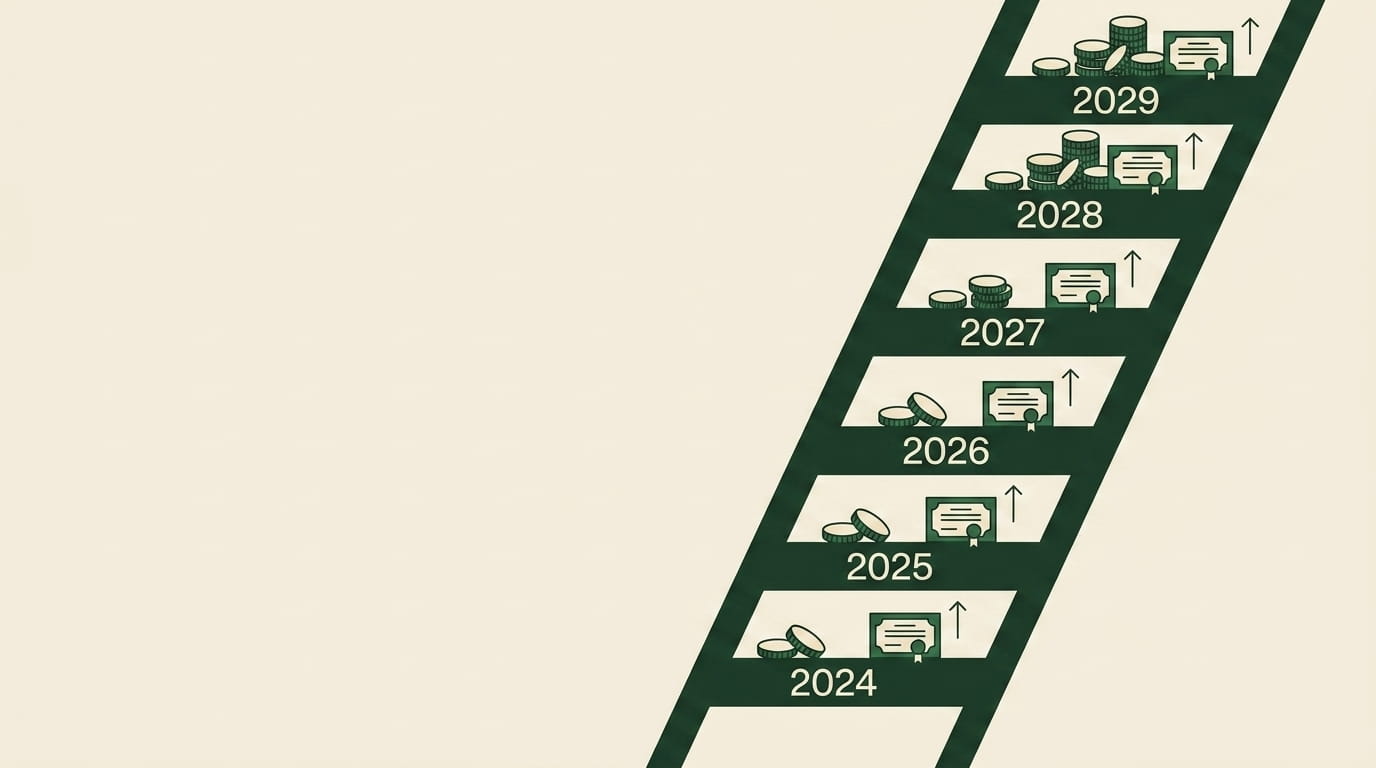
A bond ladder is one of those tools that sounds technical and turns out to be almost embarrassingly simple once someone draws it. You buy several bonds that mature in consecutive years — one in a year, one in two, and so on — and as each one matures, you either spend the cash or buy a new bond at the long end of the ladder. That is the whole mechanism. What it buys you is a predictable stream of maturing money and a built-in way to keep reinvesting at whatever interest rates happen to be.
It is worth understanding properly because it solves a specific problem — needing money on a known schedule without betting on interest rates — better than almost anything else, and worse than a plain fund for other goals.
What a bond ladder is
A single bond has one date that matters: maturity, when the issuer returns your principal. Until then it pays interest, and its market price wobbles as rates move. The key fact behind a ladder is that if you hold a bond to maturity, those price wobbles do not matter — you get your face value back regardless of what the bond traded for in between. This is most reliable with U.S. Treasury securities, which are backed by the full faith and credit of the federal government.
A ladder strings several of these together so that one matures every year. That converts a lump sum into a schedule: cash arrives on dates you chose in advance. Because you intend to hold each bond to its maturity, you are mostly insulated from the price swings that make bonds feel risky in the short term.
Building a five-rung ladder
The three decisions are how much, how many rungs, and what to buy.
- How much: divide your total roughly evenly across the rungs so no single year dominates.
- How many rungs: five is a common starting point — enough to smooth out rates, short enough to stay flexible. Some people run ten.
- What to buy: individual U.S. Treasuries are the simplest and safest building block, bought at auction or on the secondary market — you can buy them directly through TreasuryDirect or through a brokerage. Brokered CDs work too; corporate and municipal bonds add yield and complexity.
You buy one bond maturing in each of the next five years. When the one-year rung matures, you take the returned principal and buy a new five-year bond — it becomes the new top rung. Repeat annually. The ladder keeps rolling, and every year a chunk of your money resets to current rates.
A worked $50,000 example
Suppose you have $50,000 and build a five-rung Treasury ladder, $10,000 per rung, at the illustrative yields below:
| Rung | Amount | Yield | Annual interest |
|---|---|---|---|
| Matures in 1 year | $10,000 | 4.6% | $460 |
| Matures in 2 years | $10,000 | 4.5% | $450 |
| Matures in 3 years | $10,000 | 4.4% | $440 |
| Matures in 4 years | $10,000 | 4.4% | $440 |
| Matures in 5 years | $10,000 | 4.5% | $450 |
| Total | $50,000 | ~4.5% | $2,240 |
You collect roughly $2,240 in interest the first year, and in twelve months $10,000 of principal comes back. If you need the income, you spend it. If you do not, you buy a fresh five-year rung at whatever yield prevails then — which is exactly how a ladder lets you benefit if rates have risen, without being forced to sell anything if they have fallen.
Ladder vs. bond fund
A bond fund holds hundreds of bonds and never matures — its share price floats with rates every day. That is the central difference, and it cuts both ways.
A ladder gives you a date certain for your money back. A fund gives you liquidity and zero maintenance, in exchange for a price that can be down on the day you need to sell.
A ladder's strengths are predictability and control: you know the exact dates and amounts coming back, and held to maturity you are not exposed to selling at a loss. Its costs are effort — you have to buy and roll the rungs — and a bit less liquidity. A fund's strengths are that it is one click, automatically diversified, and instantly sellable; its cost is that there is no maturity date pulling the price back to par, so if you must sell in a rate spike, you sell low.
When a ladder makes sense
Reach for a ladder when you have known future expenses — a down payment in three years, tuition bills, the early years of retirement — and want the money to be there, in a specific amount, on a specific date, without depending on the market's mood that week. The matching of maturities to needs is the whole appeal.
Lean toward a fund when your horizon is open-ended, you value not thinking about it, or your balance is small enough that buying individual bonds is more fuss than it is worth. Neither is universally better. The honest question is whether you are buying a schedule (ladder) or buying exposure (fund) — and most income investors, at some point, want a little of both.