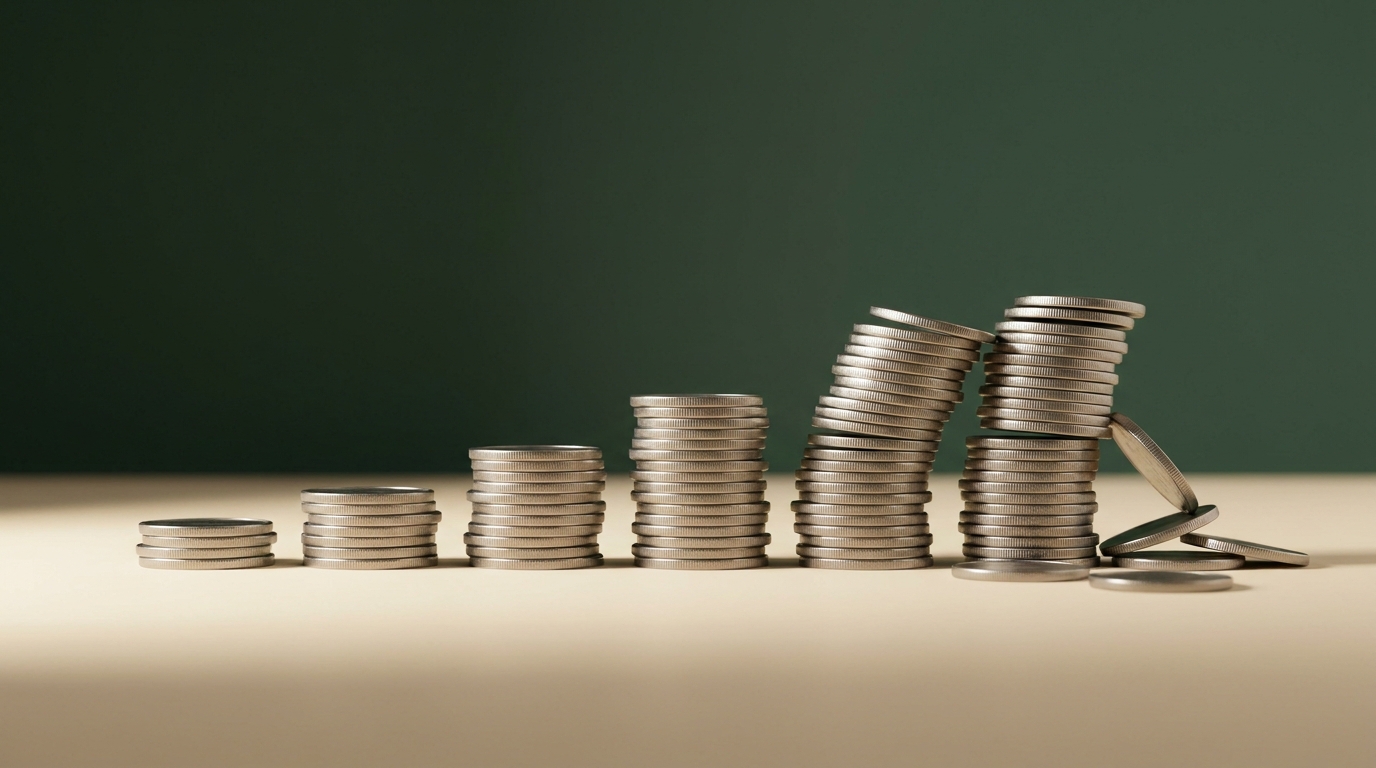
Picture the biggest raise of a career: a pre-tax salary going from $78,000 to $100,000, a $22,000 jump. The natural assumption, made on the walk home with no real plan behind it, is that this is finally the year the savings rate climbs. Then a year passes, and an honest look at twelve months of statements turns up something uncomfortable: of all that extra money, only a sliver ended up as savings. The rest dissolved into a slightly more expensive version of the same life. This worked example traces exactly how that happens.
This is the most ordinary financial story there is. It has a name — lifestyle creep, or lifestyle inflation — and it is not about reckless spending. Nobody makes a bad decision. That is exactly why it is worth pulling apart.
The raise, and the plan that never gets made
A $22,000 gross raise is not $22,000 in your pocket. After the higher marginal tax on those dollars, the increase in take-home pay lands closer to $1,250 a month — about $15,000 a year. (How much survives depends on your bracket; the IRS publishes the marginal rates that determine it.) That gap between the headline figure and the real one is the first place people fool themselves: the raise gets mentally filed as "twenty-two grand," and twenty-two grand of results are quietly expected.
The deeper mistake is structural. Nothing automatic gets done with the new money. The savings transfer stays at the amount set back when income was lower, and the extra take-home simply lands in checking every two weeks, indistinguishable from the rest. Money that arrives in a spending account with no instruction attached does not get saved. It gets spent, smoothly and without ceremony, on whatever is in front of it.
Where the money actually goes
Here is a representative picture of average monthly spending in the year before a raise, next to the year after, by category. The "change" column is the part that comes out of that $1,250 of extra monthly take-home.
| Category | Before ($/mo) | After ($/mo) | Change |
|---|---|---|---|
| Rent | $1,450 | $1,880 | +$430 |
| Groceries & dining | $610 | $880 | +$270 |
| Shopping & misc | $300 | $470 | +$170 |
| Subscriptions | $55 | $185 | +$130 |
| Transport | $240 | $305 | +$65 |
| Extra into savings | — | — | +$165 |
The categories add up to roughly $1,065 of new monthly spending against $1,250 of new take-home. What survives — the amount that genuinely becomes savings — is about $165 a month, or close to $2,000 a year. Out of a $15,000 annual raise, that is around thirteen percent kept. The other eighty-seven percent gets absorbed so gradually that no single charge ever feels like a decision.
The three creeps nobody notices
Read line by line, the leakage falls into three patterns, none of which feels like indulgence in the moment.
The upgrade that becomes the baseline. A move to an apartment $430 a month nicer is a real, deliberate choice — but once you live somewhere, the higher rent stops registering as the cost of the raise and becomes simply what rent is. Housing is where the largest, stickiest creep almost always hides, because you only re-decide it every year or two.
The hundred small defaults. Groceries and dining drift up $270 a month not through any feast but through a hundred quiet defaults: the nicer olive oil, delivery instead of pickup, the second coffee out. No line is extravagant. Together they are the second-biggest leak in the table.
The subscriptions that only ever accumulate. Recurring charges nearly quadruple, to $185 a month. Streaming, a second music service, two forgotten apps, a "free trial" that converts in silence. Subscriptions are uniquely good at creep because each one is individually trivial and none of them ever leaves on its own.
Lifestyle creep is rarely a decision anyone would defend. It is a hundred defaults nobody actually chose, each one too small to argue with.
What can be clawed back
The point is not to undo all of it. A housing upgrade you genuinely value is worth keeping; reversing it is costly and disruptive. The target is the spending that bought no noticeable happiness — the part that was pure drift.
Cancelling subscriptions that have stopped being used takes about twenty minutes and, in this example, recovers roughly $110 a month. Setting one "default" rule for food — groceries delivered once a week, dining out a planned twice rather than an unplanned six — pulls roughly $180 a month back without any sense of deprivation. Together that is about $290 a month. The decisive move is to do the one thing that should have happened at the start: automate it straight into investing the day after payday, before it can touch the checking balance.
That single change takes the "kept" share of the raise from thirteen percent to nearly forty, without changing anything about daily life that anyone could feel.
The rule that prevents it
The fix is never about budgeting harder. It is about deciding where new money goes before it arrives, so the default works for you instead of against you. The rule is simple: whenever income rises, send at least half of the increase straight to savings or investments by automatic transfer, on the same day it lands, before it ever mixes with spending money. Consumer-finance regulators such as the Consumer Financial Protection Bureau make the same core point — automating savings is one of the most reliable ways to build a cushion, precisely because it removes willpower from the equation.
Half is arbitrary, and you can pick your own split — the power is not in the number but in the timing. Money that is moved before you see it is saved without willpower; money that sits in checking is spent without intent. A raise is the rare moment to capture a permanent increase in savings at zero felt cost, because you have not yet adjusted to the higher income. Miss that window and the raise becomes invisible — not gone to anything you could name, just gone.